Focus area
MARPE and skeletal expansion
Widening the upper jaw is straightforward in a growing child and difficult in an adult, because the mid-palatal suture matures. MARPE was developed for exactly that problem. This section explains what it does, who it suits and where it stops.
The problem MARPE was designed to solve
The upper jaw is formed of two halves joined along the midline of the palate by the mid-palatal suture. In children this suture is open and responds to a conventional expander: the two halves separate, new bone fills the gap, and the jaw is genuinely wider.
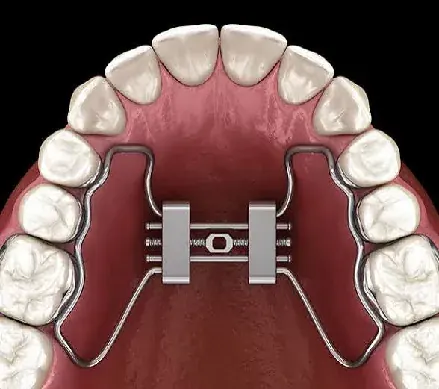
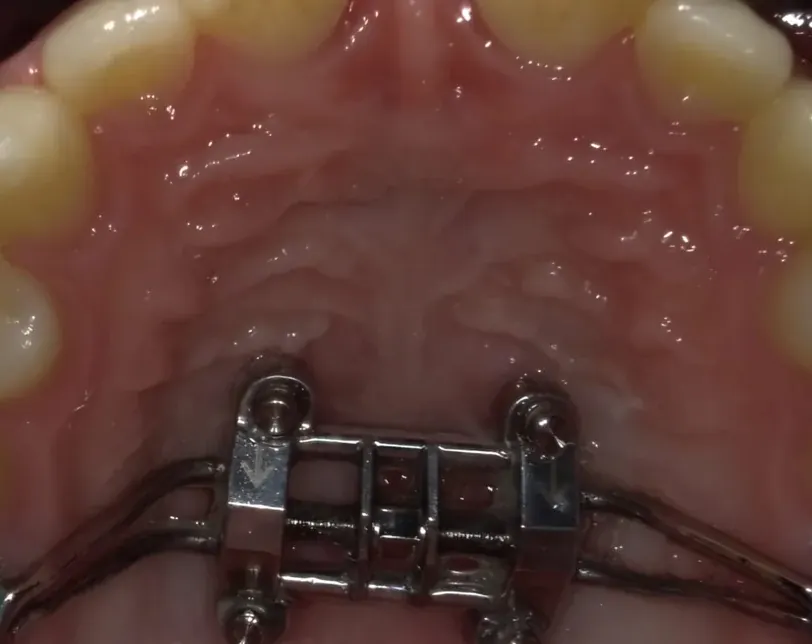
With maturity the suture interdigitates and, in many adults, fuses. A tooth-borne expander applied to a mature suture pushes on teeth rather than on bone: the teeth tip outwards, the buccal plate thins, and the skeletal width changes little. MARPE — miniscrew-assisted rapid palatal expansion, sometimes described using the closely related term MSE (maxillary skeletal expansion) — anchors the expander directly into palatal bone through temporary miniscrews, so the force is delivered to the skeleton rather than through the dentition.
Who may be suitable
- Late adolescents whose mid-palatal suture is maturing but not yet fused, in whom bone-anchored expansion may avoid a later surgical procedure.
- Adults with a diagnosed transverse deficiency — a narrow arch, posterior crossbite, dark buccal corridors, or crowding driven by arch width — where CBCT shows suture anatomy and bone quality that support a non-surgical approach.
- Patients being assessed for airway-related concerns, where maxillary width is one of several structural factors under consideration alongside medical assessment.
How the treatment runs
- Records and planning
Clinical examination, digital intraoral scan, photographs and CBCT. The appliance is designed to your own palatal anatomy and screw sites are planned from the scan.
- Fitting
The appliance is placed and the miniscrews inserted under local anaesthetic. Most patients describe pressure rather than pain.
- Activation
You turn the expansion screw yourself on a schedule set for your case. Separation of the suture is usually visible as a temporary gap between the upper front teeth — expected, and closed later.
- Consolidation
Once the target width is reached the appliance is left passive in place for a period while new bone forms in the suture. Removing it early risks relapse.
- Onward orthodontics and retention
Expansion creates the skeletal platform; aligning the teeth within it is a separate phase, followed by retention.
Comparing the expansion options
| Approach | Anchorage | Typically appropriate for | Main limitation |
|---|---|---|---|
| Conventional rapid maxillary expansion | Teeth | Growing children with an open mid-palatal suture | In mature patients it tips teeth rather than separating bone |
| MARPE / MSE | Palatal bone via miniscrews | Selected late adolescents and adults with favourable suture anatomy | Not every adult is a candidate; screws can loosen; needs CBCT planning |
| Surgically-assisted rapid palatal expansion | Surgical release plus appliance | Patients whose suture is too mature or fused for a non-surgical approach | It is a surgical procedure, with the recovery and risk that implies |
Anchored into bone, not onto teeth
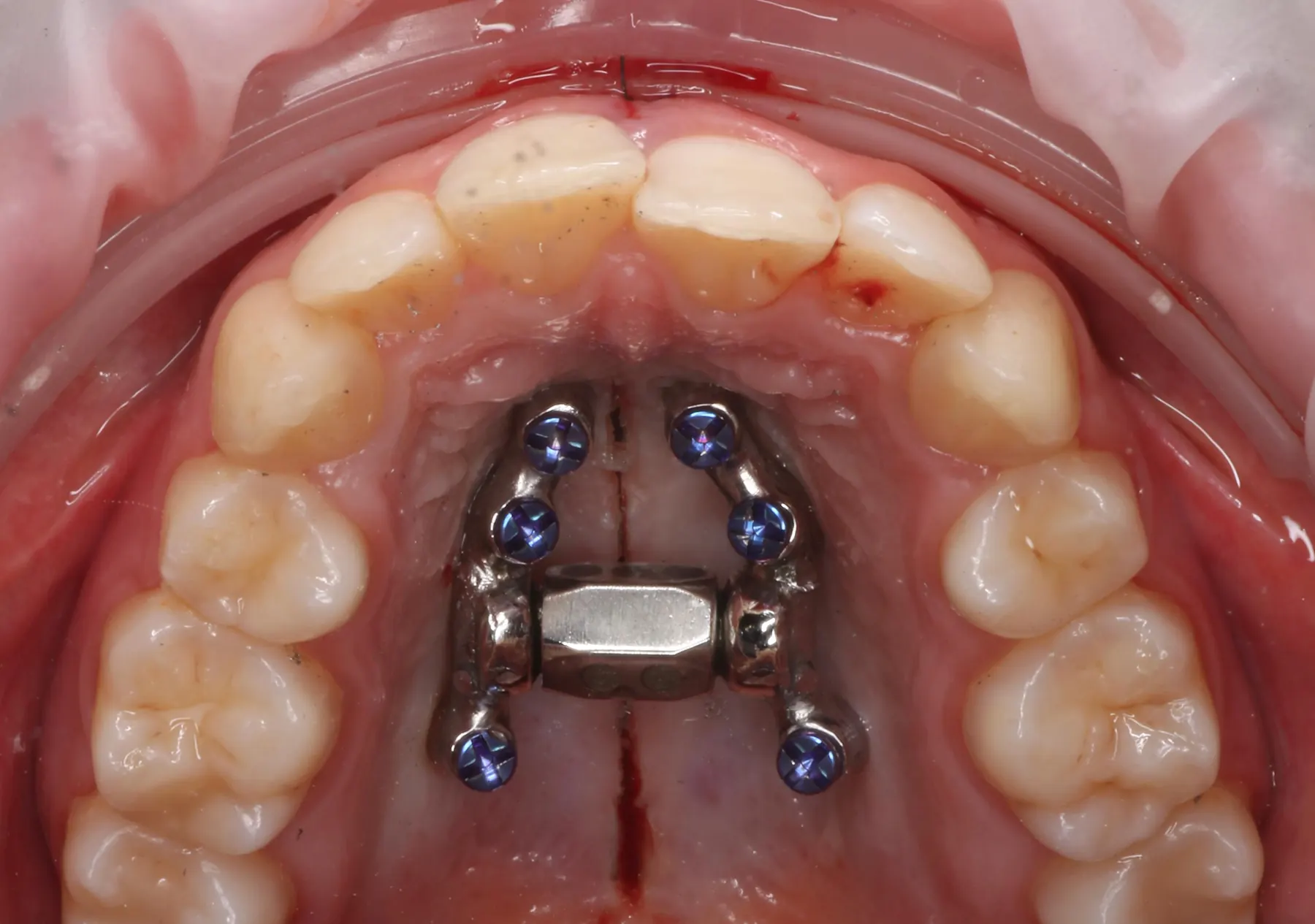
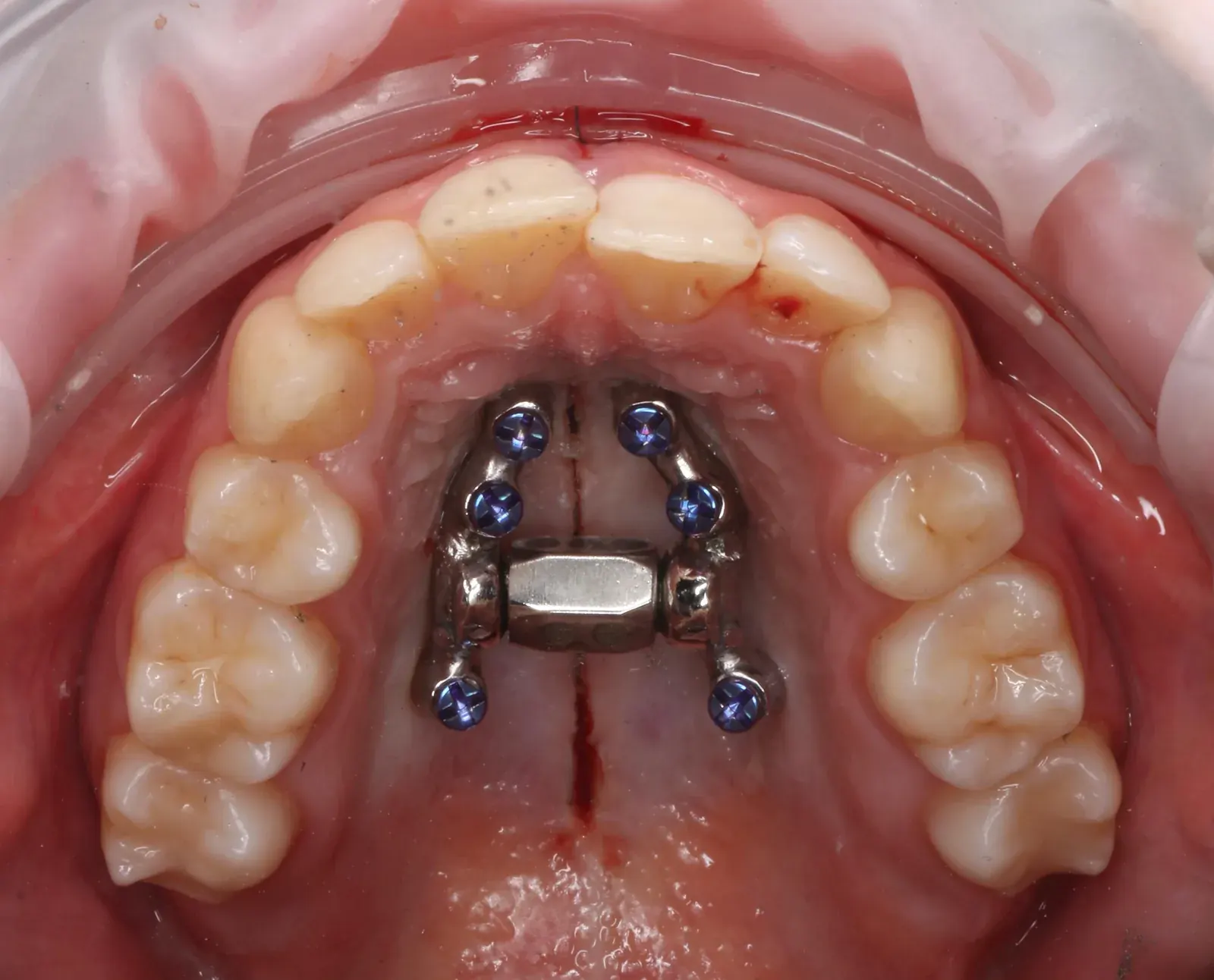
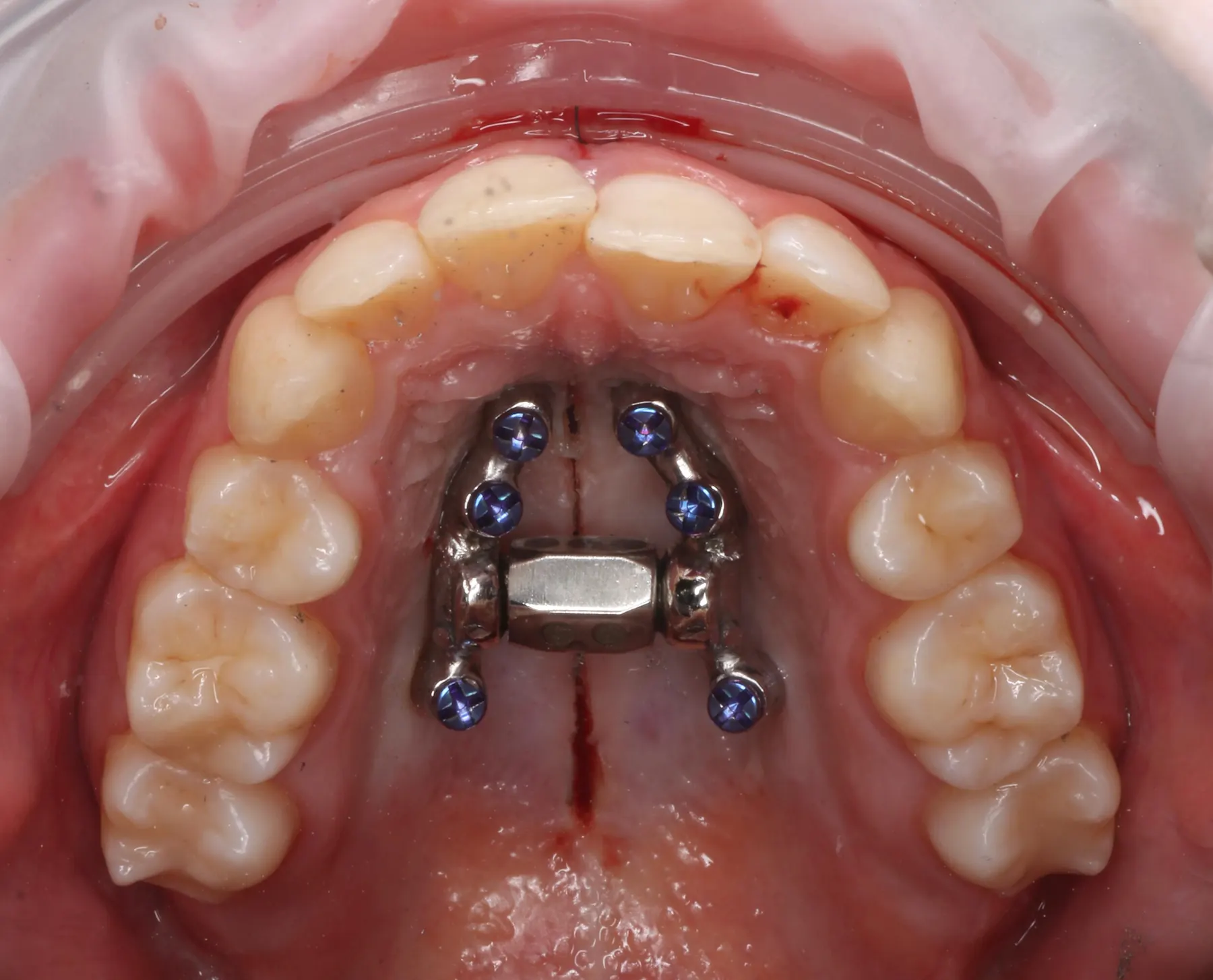
Close clinical view of a miniscrew-assisted expander, showing the expansion screw and the miniscrews anchored into palatal bone
What MARPE can and cannot be claimed to do
Can
Produce genuine skeletal widening of the maxilla in suitable patients; create arch space that may reduce the need for extractions in some cases; correct a skeletal posterior crossbite; avoid a surgical procedure where anatomy permits.
Cannot
Be guaranteed to work in every adult; treat or cure obstructive sleep apnoea on its own; produce a predictable amount of change in nasal airflow or facial appearance; substitute for medical assessment where breathing is the presenting problem.
Changes in nasal cavity dimensions have been measured after maxillary expansion, and some patients report easier nasal breathing. That is not the same as treating a breathing disorder, and it is not offered here as an outcome you should expect.
Risks and things to weigh
- Discomfort and a feeling of pressure during activation, particularly across the bridge of the nose.
- Gum irritation around the appliance, and the need for careful cleaning around the miniscrews.
- Miniscrew loosening, which occasionally requires repositioning.
- Failure of the suture to separate, in which case the plan changes — this is one reason CBCT assessment comes first.
- Relapse if the consolidation and retention phases are cut short.
- Radiation exposure from CBCT, justified against the information it provides.
MARPE treatment in Dubai
The treatment page: process, timeline, aftercare and what to expect.
Read more
Custom miniscrew MARPE
Appliances designed individually from your own CBCT anatomy.
Read more
Palatal expansion
The wider family of expansion appliances, including in children.
Read more
Narrow upper jaw
Maxillary transverse deficiency: how it presents and how it is measured.
Read more
Crossbite
Posterior and anterior crossbite, and why width matters.
Read more
MARPE cases
Before and after intraoral views from Dr. Pacha's own cases.
Read more
Frequently asked questions
What does MARPE stand for?
Miniscrew-Assisted Rapid Palatal Expansion. The closely related term MSE, maxillary skeletal expansion, describes the same principle: an expander anchored into palatal bone by temporary miniscrews rather than relying on the teeth for anchorage.
Is MARPE possible without surgery in adults?
In selected adults, yes — that is the reason the technique exists. Whether it is possible for you depends on the maturity of your mid-palatal suture and the thickness of palatal bone at the screw sites, both assessed on CBCT. Where the imaging does not support it, a surgically-assisted approach is the appropriate recommendation rather than an attempt that is likely to fail.
Will there be a gap between my front teeth?
Usually, yes, and it is a good sign: a midline diastema appearing during activation indicates that the two halves of the maxilla are separating rather than the teeth simply tipping. It is closed in the subsequent orthodontic phase.
Does MARPE hurt?
Placement is done under local anaesthetic. During activation most patients describe pressure — often felt across the nose and cheekbones — for a short period after each turn, rather than pain. Tell the clinic if what you are feeling is more than that.
How long does the whole process take?
The active expansion phase is measured in weeks; the consolidation phase that follows is measured in months, because new bone needs time to form and mature in the suture. Any subsequent alignment adds to that. Individual timelines are given after assessment, not before.
Page last reviewed: 2026-09-10. This page is general health information about orthodontic care and is not a diagnosis, a treatment plan, or a substitute for an in-person clinical examination. Suitability for any treatment described here can only be established after a consultation, clinical assessment and the appropriate records. If you have symptoms that concern you, seek advice from a qualified clinician.
Continue reading
MARPE treatment in Dubai
Miniscrew-assisted rapid palatal expansion widens the upper jaw at bone level, without surgery, in patients whose palatal…
Palatal expansion in Dubai
Widening the upper jaw is a single goal with several different techniques behind it. Which one is appropriate depends almost…
Narrow upper jaw
Maxillary transverse deficiency means the upper jaw is narrower than the lower jaw requires. It is one of the few orthodontic…
Appointments
Arrange a specialist orthodontic assessment in Dubai
Consultations take place at Manhal Medical Center, Al Safa 1, Dubai, in English or Arabic. Every assessment begins with a full clinical examination and, where indicated, 3D imaging — not a treatment quote.