Treatment
Early orthodontic treatment in Dubai
Early treatment is worthwhile when it achieves something that later treatment cannot, or avoids something worse. Applied to everything, it simply doubles the amount of orthodontics a child goes through.
On this page
Early orthodontic treatment in Dubai
The test for early treatment
There is one question worth asking before starting an appliance in a seven-, eight- or nine-year-old: what does treating now achieve that treating at twelve would not? Where there is a clear answer, early treatment is valuable. Where there is not, it adds time, cost and burden without improving the result.
Clear indications
| Problem | Why early | Typical approach |
|---|---|---|
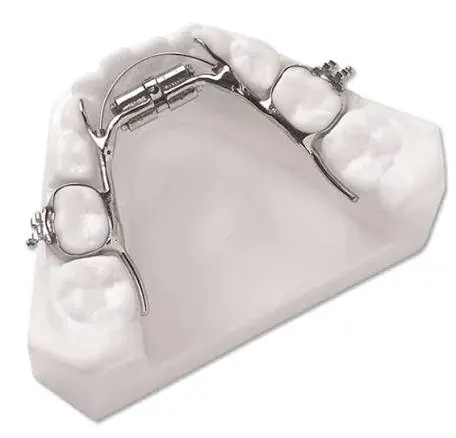
| Posterior crossbite with functional shift | The suture is open, so expansion is straightforward; a persistent shift loads the joint asymmetrically | Rapid maxillary expansion |
| Anterior crossbite / developing Class III | Maxillary protraction works best before about age ten while sutures respond | Protraction facemask, usually with expansion |
| Markedly increased overjet | Prominent upper incisors carry a substantially higher risk of trauma | Functional appliance, or a partial fixed appliance |
| Ectopic canine eruption | Timely removal of a primary canine can redirect the permanent tooth and avoid surgical exposure | Extraction of the primary canine, with radiographic monitoring |
| Early loss of primary molars | Adjacent teeth drift into the space intended for the permanent successor | Space maintainer |
| Persistent digit sucking with an open bite | The dental effect is often reversible if the habit stops before the permanent incisors are established | Habit management, occasionally a habit-breaking appliance |
Where early treatment is usually not indicated
- General crowding in the mixed dentition, which frequently changes as permanent teeth erupt.
- Mild spacing, which often closes on its own.
- Aesthetic concerns about individual teeth before the permanent dentition is established.
- Mild increases in overjet or overbite with no functional consequence.
Frequently asked questions
Is early treatment always better?
No. It is better for specific problems — crossbites, developing Class III patterns, very prominent incisors, ectopic canines, space loss. For general crowding, evidence does not show that two phases beat one well-timed phase, and two phases mean longer overall treatment.
Will early treatment mean my child avoids braces later?
Usually not. Early treatment addresses a specific problem; a second phase is generally still needed to align the permanent dentition. Where it genuinely avoids surgery or trauma, that trade is worth making — but it should be presented honestly.
How is my child monitored if no treatment is needed now?
With periodic review appointments and, where indicated, radiographs at appropriate intervals — particularly to track canine position, which is one of the more time-sensitive things to watch.
Page last reviewed: 2026-09-10. This page is general health information about orthodontic care and is not a diagnosis, a treatment plan, or a substitute for an in-person clinical examination. Suitability for any treatment described here can only be established after a consultation, clinical assessment and the appropriate records. If you have symptoms that concern you, seek advice from a qualified clinician.
Appointments
Arrange a specialist orthodontic assessment in Dubai
Consultations take place at Manhal Medical Center, Al Safa 1, Dubai, in English or Arabic. Every assessment begins with a full clinical examination and, where indicated, 3D imaging — not a treatment quote.